
SEAMS


Launch: Friday 31 March 2023, 7–9pm
SEAMS is a solo exhibition by Laura Wilson comprising three installations including a significant new body of work entitled Winding, then Winding. Laura is interested in how everyday materials such as bricks, textile, wheat, salt and bread dough transmit historical and embodied knowledge between people over time and place. Laura develops research-led projects, working with specialists and experts to communicate relationships between materiality, memory and tacit knowledge, explored through sculpture, performance, drawings and video. This exhibition is a survey of Laura’s recent works connected by the body, learning, movement and labour.
Winding, then Winding (2023) is informed by Laura’s research into her family history, the production and export of linen through the Derry~Londonderry ports and the history of Linenopolis, the name given to her hometown of Belfast in the 19th Century when it was at the centre of the world’s linen industry. This work builds upon previous works investigating how the body learns, adapts, responds to and performs manual work. Over the past 18 months the artist has been learning how to weave linen, whilst researching the social history of the fabric and its facture. One of the strongest fibres in existence, linen traditionally requires skilled people to produce it. The works in the exhibition are inspired by the architecture and physical movement of operating a loom as well as the social and personal histories of linen production. Laura’s ancestors worked in factories in Portadown and Lisburn as weavers, warpers and yarn winders and she explores ways information is passed on from one person to another and between generations, in particular how knowledge can be stored within the body. Developed in parallel with Laura’s changing pregnant body, with the largest works produced post-partum and taking their structure from the cycle of her day caring for her newborn - changing the weaving pattern or weft yarn following nursing or soothing. The linen maps the passage of time as a new parent, growth spurts, cluster feeding and naps. Laura considers that as a counterpoint to the increasing pace of mechanical production and often invisible, outsourced labour of today’s new technologies and unsustainable production of fabrics for fast fashion as well as the relationship between women’s work and labour.
Laura’s table loom forms part of the installation and she will weave alongside her mother, whom she is teaching to weave, on the first day of the exhibition. Throughout the run of the exhibition weavers are invited to contribute to a collective weaving on the loom.
Showing alongside this work is Deepening (2020) a video commissioned by New Geographies and Norwich Castle Museum & Art Gallery and To The Wind’s Teeth (2021) commissioned by the Landmark Trust.
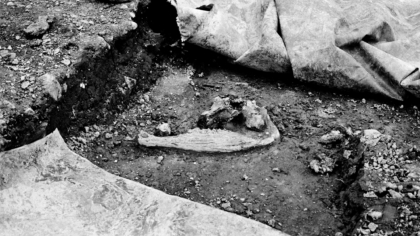
Deepening is presented alongside costumes and performance tools from Deep, Deepen, Deepening (2019). This work resulted from Laura’s research into Must Farm, an exceptionally well-preserved Bronze Age settlement (c. 850 BC) at the edge of a working brick quarry near Peterborough. Laura worked closely with archaeologists and brick quarry workers, researching the found objects and questioning labour, trade, everyday life both in the past and now. The film brings together documentation from the performance alongside hand-held footage filmed during her research and additional footage featuring twelve Bronze Age vessels excavated from the Must Farm site.
To the Wind’s Teeth (2021) is a film presented alongside the costumes and performance tools featured. This site-specific work was produced in Llwyn Celyn, situated in the Llanthony Valley at the edge of the Brecon Beacons National Park. Llwyn Celyn is regarded as one of the most remarkable of all surviving late-mediaeval houses in Wales. The house’s adjacent threshing barn inspired Laura, a space where wheat would have been used to thrash and winnow the edible grain from locally harvested wheat, bringing together craft, work and the home.
Supported by a bursary from a-n The Artists Information Company; funded by the County Durham Community Foundation’s Dover Prize Fund, Arts Council of Northern Ireland and Derry City & Strabane District Council.
Laura Wilson was born in Belfast and lives and works in London. She is interested in how history is carried and evolved through everyday materials, trades and craftsmanship, working with specialists to develop sculptural and performative works that amplify the relationship between materiality, memory and tacit knowledge. Wilson’s interdisciplinary and research-based works have been exhibited widely including at: Site Gallery, Sheffield (2022); The Collection, Lincoln with Mansions of the Future, UK; First Draft, Sydney, Australia; The Landmark Trust, Wales, UK (2021); 5th Istanbul Design Biennial – Empathy Revisited: Designs for More than One; Norwich Castle Museum & Art Gallery, Norwich, UK as part of New Geographies (2020); The British Museum, London, UK with Block Universe; Kettle’s Yard, Cambridge, UK; and The Petrie Museum of Egyptian Archaeology, London, UK (2018); SPACE, London, UK; V&A Museum, London, UK; and Invisible Dust at Hull and East Riding Museum, Hull, UK (2017); Delfina Foundation, London, UK (2016 & 17). Site Gallery, Sheffield, UK (2016); Whitstable Biennial, UK (2014); Camden Arts Centre, London, UK and Turner Contemporary, Margate, UK (2013); W139, Amsterdam and De Warande, Turnhout, Belgium (2012). She is currently the MIMA Kitchen & Garden Artist in Residence where she has been encouraging new conversations and connections around food, nutrition and local producers in the North East of England. A Churchill Fellow, Wilson was awarded the inaugural Jerwood New Work Fund 2020 and the Dover Prize 2021.
Download a sensory map for SEAMS by clicking here.
Laura Wilson, Seams (detail), 2023
Image courtesy of the artist.
Laura Wilson, Deep, Deepen, Deepening, 2020
Commissioned by New Geographies and Norwich Castle Museum & Art Gallery. Photo: Rui Pignatelli.
Laura Wilson, Deepening, 2020
Still from video, 15:36 minutes.
Image courtesy of the artist. Commissioned by New Geographies and Norwich Castle Museum & Art Gallery.
Laura Wilson, To the Wind's Teeth / I Ddannedd y Gwynt, 2021
Still from video 11:19 minutes.
Image courtesy of the artist. Commissioned by The Landmark Trust.
Download the text here.
SEAMS
SEAMS is an exhibition of new and revisited work by Laura Wilson, at CCA Derry-Londonderry. It happens to coincide with news that First Source, a large call centre regarded as an important regional employer, is to make over four-hundred redundancies, seen as a stepping stone toward an inevitable full withdrawal in favour of less expensive labour elsewhere. The news reverberates throughout the city as an echo of Derry’s historic role in the textile industry, where as the home of “the shirt factories” Derry was an exporting hub of manufactured textile goods—until the industry moved on to more ‘competitive’ locales.
Much of the fabric originated further up the chain, at the so called ‘Linenopolis’ of Belfast, which is the conceptual starting point of Wilson’s new work for the occasion of this exhibition at the CCA. For Winding, then Winding (2023) the artist spent 18-months learning how to weave Linen, while researching its social and industrial history and the artist’s own family’s history in the industry. The installation at CCA represents this research process: 6 Linen weavings, reminiscent of tasselled scarves or table runners, hang vertically from wooden rails on one wall of the space.
They are not uniform, neither as a series or even within themselves: three are a natural beige, and three others a segmented gradient of blue, khaki and burgundy. The beige weavings have a protean character that alternates in sections along the length of the fabric, suggesting a textural cartography developed along axes of time and learning, experience and intuition. Most discernible sections, of either texture or colour, are marked by scraps of paper affixed with sewing pins and numbered in ascending order, but in what pattern is unclear—we are left to wonder what these numbers signify.
Collaborative research is an integral part of Laura Wilson’s practice, and for SEAMS the artist collaborated with their mother, whom she taught to weave Linen using a wooden table loom on the first day of the exhibition. The table loom is part of the exhibition, and weavers are invited to contribute to an ever-growing work-in-progress. More of the arcane sets of numbers are written on stickers around the sides of the loom’s frame beneath rows of mechanical levers and switches, inviting a viewer to investigate what process or rubric relates these notes to those pinned on the finished pieces. A viewer begins to learn something about the process of weaving, directly taking part in the transfer of knowledge that so interests the artist.
Wilson became pregnant during the course of the research, which informed their evolving practice physically and conceptually. The gradual physical changes in a pregnant body required adaptations over time, particularly to the table loom, prompting one to reflect on the able-bodied demands of labour. When baby Jack was born, the artist’s caring responsibilities became an agent in their practice, as nursing, changing and feeding became a metronome by which the weaving practice changed. A long, single Linen cloth is draped over three suspended wooden racks: along its length are strata of different patterns and methods, each representing a liminal time between parental responsibilities. We begin to see the acts of child-care (such as winding after feeding) and the physical labour of winding thread into a loom as syncretic gestures—”Winding, then Winding”—abstracted into a lens of work measured in time and care, rather than capital.
Deepening (2020) is a video and installation relating to Wilson’s earlier performance Deep, Deepen, Deepening (2019) that took place at Must Farm Quarry, near Peterborough. Must Farm is a well preserved Bronze Age settlement located at the edge of the quarry, where Wilson has researched both archaeological artefacts and the modern practices of workers at the quarry, critically mining for insight on work, trade and the everyday of both epochs.
The performers use wooden brick-hods — traditional brick carrying tools — to perform rhythmic sweeping, scratching and beating around the surface of a terracotta-bricked circular platform, before joining the hods together vertically and rotating like a mill-stone. Distinct teams emerge, where the labour is divided into the brick-hod wielders, and those working with their hands to mortar, or bang and scrape bricks together. The bright yellow overalls — dyed by the artist — and muddied boots worn by the performers are installed at the opposing wall in the CCA, along a long, modular locker that suggests an industrial setting.
To The Wind’s Teeth (2021) is a video installation of a site specific performance work at Llwyn Celyn, a preserved Medieval house in Llanthony Valley, Wales. Four performers wearing white overalls and woven talismans use grain-flails to rhythmically thresh and sweep at the floor, then collaboratively winnow mounds of grain. The result is a labour-intensive soundscape of banging and scraping, then a haze of grains clattering on the floor. After all this, each performer pockets a handful of grains, suggesting payment.
The costumes and implements featured in To The Wind’s Teeth are also part of the exhibition, continuing a theme of physically evidencing the performances in an almost archeological gesture. The symbolic archeology of the performance is mirrored by the installation in the gallery, and by examining the artefacts a viewer implicitly becomes an actor in a growing body of knowledge.
This praxis of work as a social exchange, not wage labour, is an instructive lens to view Wilson’s oeuvre. The economy symbolised by the grain threshing performance To The Wind’s Teeth is one of subsistence: being paid with the very grain that will feed one’s family (if even.) Although we shouldn’t glamourise the likely exploitative conditions of medieval labour, this work does offer conceptual breathing room to consider labour and economy unfiltered by currency as we understand it: working to eat, to subside—to survive—without the extra step of using wages to purchase survival in a market. Deepening offers a complementary glimpse into a kind of pre-economic history: some of the performers appear to echo the ancient residents of Must Farm, banging and scratching rocks together with their bare hands, promethean attempts to spark the flame that might have fired the pottery eventually recovered from the quarry. This is labour that speaks to more than survival, but to community and to place-making, that left to us the artefacts testifying to the skill of these people. The banging of rocks brings to mind the seemingly tacit knowledge intuited by infants and adolescents as soon as they set hands on a few Lego bricks, a gesture of cause and effect inspired by our earliest sensations.
I once worked with someone who originally trained in repairing the sewing machines of Derry’s shirt factories. The social capital invested in the training—the collective wealth of society, not to mention their time—is only partially returned: society collectively invested in a wage-labour model that would inevitably abandon it. In Laura Wilson’s work, there is both a tragic portraiture of social labour in service of un-social economics, but also a reclamation of skills for the social, place-making exchanges of art.
Kevin Burns, 2023
Roundtable Podcast with Laura Wilson, Kerrí Ní Dochartaigh and Claire Whelan.